What I Learned Writing Two Papers About a Sculpture That Didn't Fully Survive
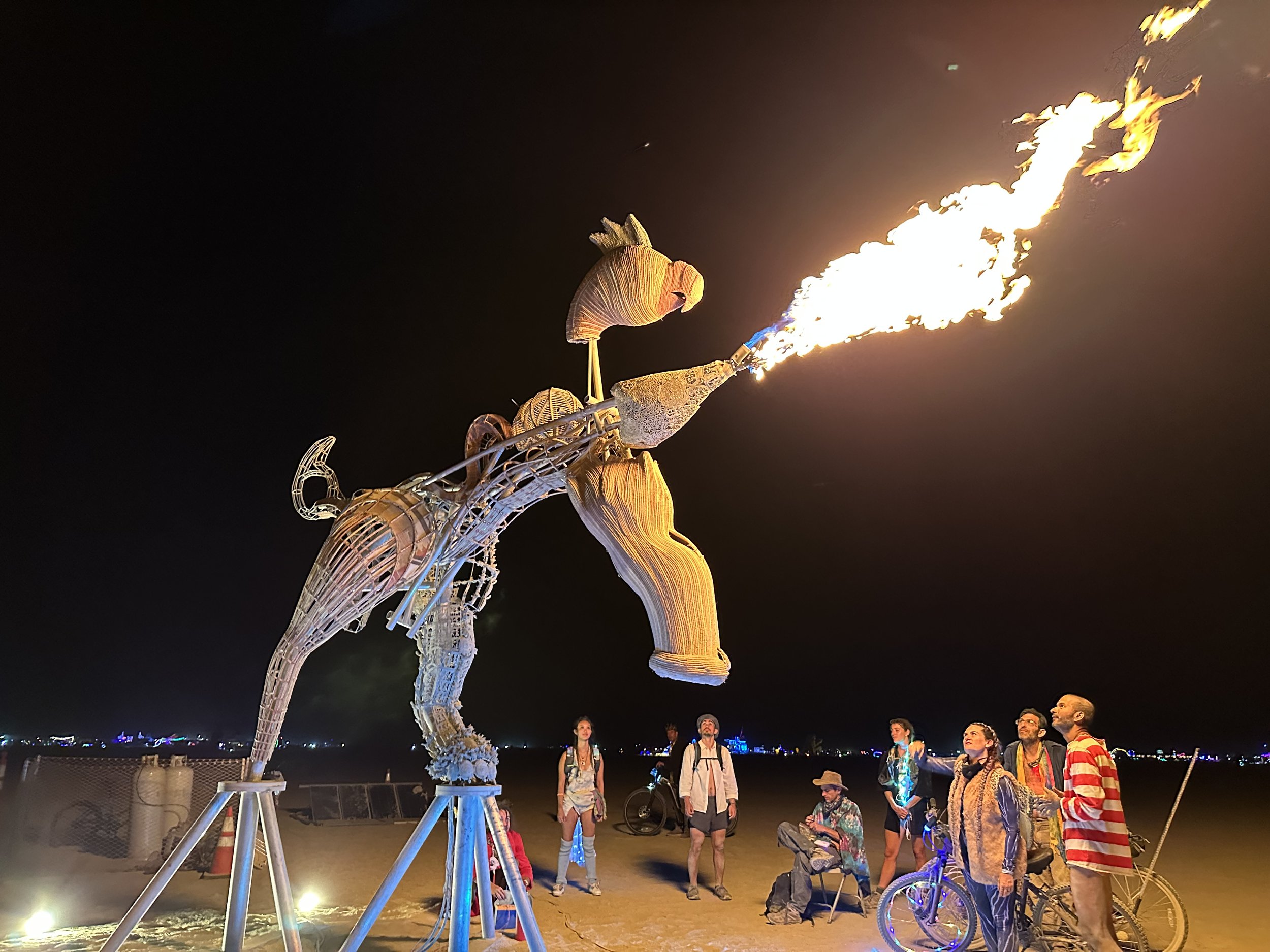
Some of the named pieces — Rajesh Moharana's bronze sculpted arm, the top half of the tigress Dhokra leg, and Swig Miller’s flame effects apparatus — were taken from the playa staging area during teardown, September 3, 2025. The papers still hold their names. Entropy has more than one instrument.
Everything falls apart
This is the starting point. Entropy increases. Structure decays. Craft traditions die when the last practitioner dies. Languages go silent. A culture, a skill, a myth — left alone, they dissolve. That isn't pessimism. It's the ground condition that makes building anything remarkable.
We tried to build something anyway
We wrote burn equations. Real ones — parameterized energy release, surface-area-weighted heat rates, duration estimates for an 18-foot cane structure. We computed how long it would take for the sculpture to return to ash in a ceremonial fire at festival close. FAST review and LNT protocols stopped the open burn. What replaced it was better than what we'd planned: controlled poofer flame effects, designed by Swig Miller, that let the creature breathe fire from its outstretched arm into the desert night. The pivot from self-immolation to living flame changed the sculpture from something that would have died in fire to something that wielded it. But the deeper point was never about the object surviving or burning. It was about the arc: take a myth, expand it into physical form with real people's hands, witness it. The full-burn concept wasn't destruction. It was the second half of a cycle we only got to complete the first half of. The flame effects gave us something the burn never would have — a creature that stood there, alive, breathing fire, night after night.
The names matter more than the equations
If you read the two papers and take away one thing, let it be Table II in the parametric paper. Not the kernel dynamics, not the assembly index conjecture. The table. Malli Mani Nayak weaving sabai grass into the rooster head. Jagabandhu Panika showing up with kotpad weaving that wasn't even in the original proposal. Purnachandra Ghose adding pipli appliqué because that's what the piece needed when he saw it.
These craft traditions — sabai weaving, dhokra casting, pattachitra painting — are high-complexity cultural objects built up over generations in a world that is not trying to keep them alive. What the papers do is put those names and those contributions into an academic record. It's a small thing. But the record will outlast the sculpture, the playa, possibly the practitioners. These people existed, did this specific thing, on this date, in this desert, and nobody can undo that sentence.
We know entropy is winning. We make things anyway. We write down the names.
We didn't finish
Seven of nine animal sections went up. The chest and neck didn't make it — cantilever moments, compressed schedule, storms. The papers don't hide this. They record it as a partial execution of assembly step 12.
I've come to think this is the most honest part of the whole project. Every life is a partial execution of its assembly path. The right response isn't to pretend the missing sections were never planned. It's to document what the full assembly would have required and leave the record open. The 75 mph wind gust requirement was real. The storms were real. The compressed timeline was real. If we'd executed perfectly, it would mean the constraints weren't hard enough. We were working at the edge. That's the only place where anything interesting happens.
Why the Navagunjara
The Navagunjara — nine animals fused into one being, from the Mahabharata as told in Odisha — has been a stable form in Odia cultural space for centuries. Painters, sculptors, storytellers have all orbited it. In one of the papers we call it "a maximum-entropy configuration over animal morphologies": the most diverse composite that still holds together as a single creature. That the myth arrived at what amounts to a mathematical principle millennia before anyone wrote the math is something I only recognized after the framework took shape.
Myths are cultural attractors. They're stable across centuries, capable of seeding new work in contexts their originators never imagined — a Nevada desert, an academic paper, a 3D printer running at midnight in my Arizona lab. We're attractor-seeking animals. We find the seeds that have survived the most disruption, and we expand from them into our own moment. We attach seven of nine sections. We document the other two.
What remains
Art is the record that the expansion happened. These papers are the record that these specific people — named, from specific places — ran the expansion from a specific mythological seed, and the trajectory left marks: a sculpture photographed by Kyle Breen on the playa at night, a weaver in Odisha who worked on something that crossed an ocean, a grad student somewhere reading a burn-duration equation at 2 AM and laughing because it is both absurd and completely serious.
The sculpture stood on the playa. Parts of it remain. The papers exist. The names are in them. Navagunjara will be born.
Companion manuscripts:
Engineering Mythology: A Digital-Physical Framework for Culturally-Inspired Public Art, 2025. https://arxiv.org/abs/2603.27801
Digital-Physical Twins for Monumental Art: A Parametric Kernel-Dynamics Framework [PDF]
— Jnaneshwar Das, Tempe, Arizona
From Meshes to Meaning: AI-Assisted Digital Twin Synthesis
STL files might be ubiquitous in the world of 3D modeling, but they're not ideal for precise CAD workflows. What they do offer, though, is a convenient on-ramp for sculpting and rapid ideation—especially when working with tools like Blender, where artistic flexibility meets procedural control through hybrid mesh and surface modeling.
This creative foundation becomes even more powerful when connected to modern AI and computer vision pipelines. Thanks to insights from board member Harish Anand, I’ve recently deepened my understanding of how AI-assisted tools can help bridge the gap between rough digital assets and refined, contextualized digital twins. It’s a critical part of my work, which sits at the intersection of robotics and the sciences. Now it is enabling continuous ratcheting of innovation between science and art—an idea inspired by another board member, Dr. Ramon Arrowsmith in the context of science and engineering.
LLMs as Creative Co-Designers
Large Language Models (LLMs) are more than chatbots—they are becoming embedded infrastructure in design and engineering workflows. I use:
Cursor IDE: A deeply integrated development environment that combines Claude and other LLMs with intelligent code context.
Claude MCP: Tools that leverage the Model Context Protocol (MCP) to standardize interactions with AI systems, bridging context between modeling platforms and AI assistants.
Together, these tools let me manage complex, context-rich modeling pipelines with greater fluency and modularity.
Navagunjara and DeepGIS-XR: Fusing 3D and 2D Worlds
Ongoing Navagunjara Reborn Burning Man Honoraria Art Grant Project with Richa Maheshwari (Boito) found a natural integration with DeepGIS in an attempt to blend narrative and spatial data—combining digital twins with architectural and cartographic layers. This approach enables hybrid reporting, where immersive 3D visualizations remain traceable to 2D plans, eventually through GIS systems, with metadata-rich documentation.
This is not just about visualization—it's about reproducibility and traceability, which are essential whether you're building a robot armature or coordinating a mixed-media art installation.
Model Context Protocols: Interoperability by Design
A key enabler of all this is the Model Context Protocol (MCP), which was first brought to my attention this March by our Burning Man camp mayor, Christopher Filkins. It's a relatively new open protocol that allows client applications—such as Blender, FreeCAD, Cursor, and Claude Desktop—to share structured context with one another.
Using Blender-MCP and FreeCAD-MCP, I can:
Maintain semantic fidelity from generative AI outputs to engineering models.
Enable bidirectional context updates (e.g., changes in text-based reasoning or geometry sync across clients).
Automate capture of modeling intent, assumptions, and constraints—making them visible and machine-readable.
The Claude MCP clients showcased at claudemcp.com are a good place to start exploring this ecosystem. Applications like Cursor illustrate how distributed tools can coordinate design logic, AI prompting, and multi-modal outputs through a shared protocol.
In closing, the convergence of sculpting tools, AI co-pilots, and interoperability standards like MCP is reshaping how we think about design and fabrication. Whether you’re working with robots, installations, or digital city models, the power to integrate vision, language, and geometry into a single contextual loop is finally within reach.
Jnaneshwar Das,
Tempe, Arizona
Welcome to the Earth Innovation Hub!
Earth Innovation Hub (EIH) was founded with the vision of cultivating a collaborative ecosystem where innovations in Robotics and AI could serve both Earth and Space Sciences. Our community thrives on the cross-pollination of ideas—from cutting-edge engineering to artistic storytelling. At the heart of this mission lies a commitment to openness, inclusivity, and shared progress.
Originally launched in January 2019 to support DREAMS Laboratory and the NSF Cyber-Physical Systems Student UAV competitions, our Slack workspace has since evolved into a robust network of 107 members across universities and institutions. In 2024, our first year as a registered nonprofit, we continued to expand our research capabilities, community outreach, and technical infrastructure.
Highlights of our journey span robotics field tests to digital twin simulations, from high-altitude balloon experiments to public art installations, our activities reflect a broad and bold vision for impact.
Thank you for supporting and contributing to the Earth Innovation Hub. Here's to shaping a more innovative and interconnected future together!
Jnaneshwar Das
Tempe, Arizona